
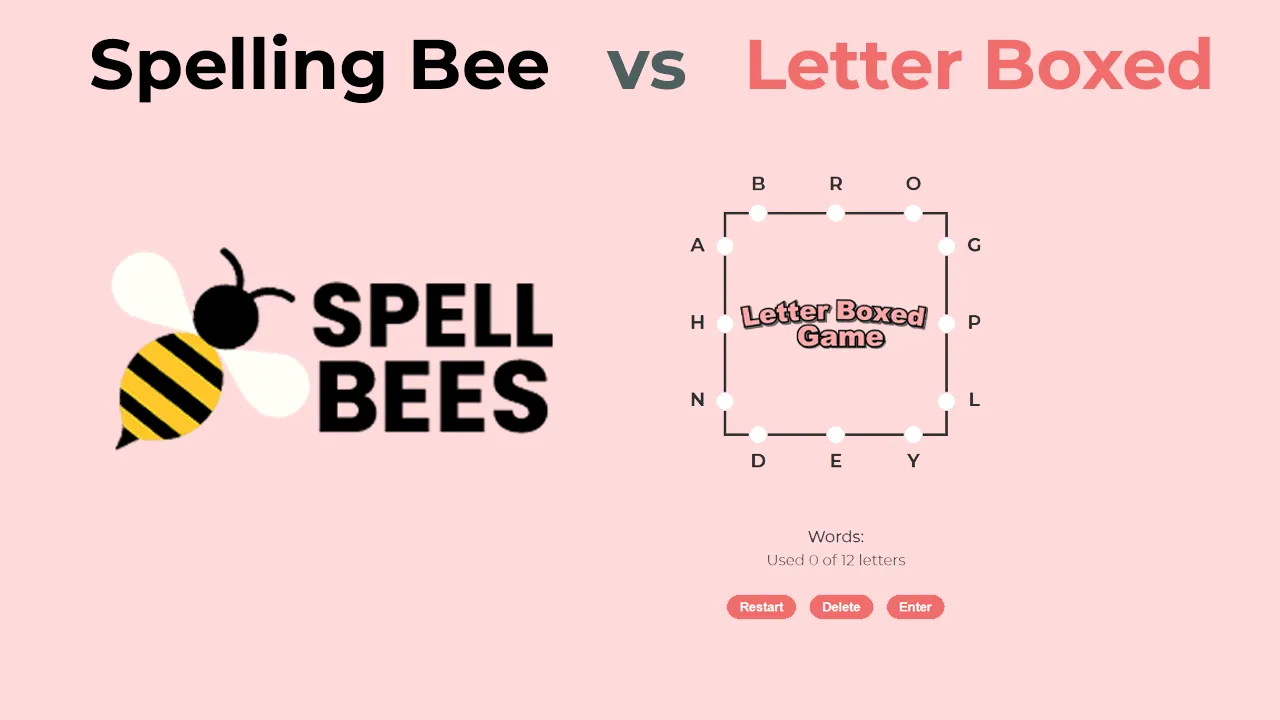
Quick Overview: Key Differences at a Glance
| Feature | Letter Boxed | Spelling Bee |
|---|---|---|
| Gameplay Style | Form a word loop around a square | Make words from 7 letters arranged in a honeycomb |
| Cognitive Focus | Spatial logic + multi-step planning | Pattern spotting + word family intuition |
| Average Time | 3–6 minutes | 15–40 minutes |
| Challenge Style | All-or-nothing: solved or not | Gradual: from “Good” to “Genius” |
| Peak Satisfaction | Completing a flawless two-word loop | Discovering the Pangram |
| Ideal For | Strategic, methodical thinkers | Language and vocabulary enthusiasts |
Why These Two Puzzles Are Often Compared
Both are daily challenges, both strengthen vocabulary, and both offer that addictive “aha” moment. However, each targets a different type of thinking:
Letter Boxed is perfect for players who enjoy visualizing sequences, planning moves ahead, and condensing complexity into elegant solutions.
Spelling Bee appeals to those who love exploring language, spotting recurring patterns, and progressing through incremental challenges.
Most daily puzzle enthusiasts try both Letter Boxed Daily and Spelling Bee Daily, then naturally gravitate toward the puzzle that suits their thinking style.
This guide will help you determine which puzzle resonates with your brain.
What Letter Boxed Tests Beyond Simple Word Creation
At first glance, Letter Boxed seems straightforward , but it’s essentially a logic puzzle disguised as a word game. The board isn’t just letters; it’s a system of constraints.
Here’s what the puzzle challenges:
Spatial Awareness
You’re navigating a word loop around a square. Your brain maps edges and corners to visualize your next move effectively.
Planning Ahead
Success depends on mapping multiple moves in advance. A poor start can trap you quickly.
Letter Management Strategy
Experienced players save certain letters for the end so the chain closes smoothly.
Creative Problem Solving
Unexpected word choices often work best. Ending a word with versatile letters allows more options than hitting a dead-end letter like “X.”
Example
For a board with R, M, A, D, ending a word with A can open multiple transitions, while ending with D can severely limit your choices.
What Spelling Bee Tests Beyond Vocabulary
Spelling Bee has a gentler difficulty curve but offers richer linguistic exploration. Players often enter a “flow state” once they detect letter patterns.
Pattern Recognition
Top Spelling Bee players quickly identify patterns such as:
- ➥-ing
- ➥-ion
- ➥-ate
- ➥consonant + vowel + consonant
Recognizing these patterns can unlock 10–20 words in one go.
Understanding Word Families
Spelling Bee trains you to see how prefixes and suffixes evolve across related words. For instance:
harm
→ harmful → harmony → harmonize.
Stepwise Progression
Players experience growth through tiered rankings:
- ➥Good
- ➥Great
- ➥Amazing
- ➥Genius
- ➥Genius+
This tiered system keeps engagement high and provides a sense of continuous achievement.
Exploring Vocabulary
Unlike Letter Boxed’s tightly constrained structure, Spelling Bee encourages experimentation. The more you play with the available letters, the more hidden words you discover.
Letter Boxed vs Spelling Bee: Skill Comparison
| Skill | Letter Boxed Strength | Spelling Bee Strength |
|---|---|---|
| Vocabulary Expansion | Moderate | High |
| Pattern Recognition | Moderate | Very High |
| Multi-Step Planning | Very High | Low |
| Strategic Thinking | High | Medium |
| Creativity | High | Moderate |
| Time Requirement | Low | High |
This table makes it clear: Letter Boxed prioritizes strategy, while Spelling Bee emphasizes language exploration.
Difficulty Comparison: Which Puzzle Challenges You More?
Difficulty largely depends on how your mind works.
When Letter Boxed Feels More Challenging
- ➥You struggle to plan multiple steps ahead
- ➥You prefer open-ended, free-form puzzles
- ➥You dislike “all-or-nothing” outcomes
- ➥You rely more on vocabulary than strategy
Letter Boxed’s difficulty is binary: either you complete a perfect two-word loop, or you fail.
When Spelling Bee Feels More Challenging
- ➥You get overwhelmed by too many choices
- ➥You feel anxious when you don’t see all possible words
- ➥You dislike progressive difficulty curves
- ➥You prefer puzzles that resolve quickly
Spelling Bee rewards endurance and patience over precision planning.
Time Commitment: Which Puzzle Fits Your Day?
Letter Boxed:
Quick, intense, and mentally stimulating. Ideal for:
- ➥A short morning break
- ➥Waiting in line
- ➥A rapid brain warm-up
Spelling Bee:
Engaging, immersive, and exploratory. Best suited for:
- ➥Evening play sessions
- ➥Relaxed, distraction-free environments
- ➥Puzzles with tea, snacks, or background music
“Cognitive Load”
Letter Boxed: High intensity in a short burst
Spelling Bee: Lower intensity but sustained over longer periods
This factor alone often guides players’ preferences.
Which Puzzle Boosts Vocabulary Faster?
Letter Boxed
Playing teaches:
- ➥Transitional words
- ➥Connective vocabulary
- ➥Uncommon word endings
However, growth is somewhat limited by the small board size.
Spelling Bee
Playing teaches:
- ➥Root word families
- ➥Latin and Greek-based structures
- ➥Word expansions
- ➥Layered vocabulary levels
For pure vocabulary growth, Spelling Bee clearly has the edge.
Strategy Differences: How Your Brain Works in Each Puzzle
Letter Boxed Strategy Example
Choosing a first word that ends with E gives you flexibility for nearly any next consonant, whereas ending with J may trap you in a dead-end sequence.
Spelling Bee Strategy Example
Focus on:
- ➥Repeated letters
- ➥Common suffixes
- ➥Vowel-heavy extensions
- ➥Word stems like ser-, tra-, con-
Both games demand creativity, but in very different ways.
Which Puzzle Feels More Rewarding?
If you enjoy clear, precise solutions, Letter Boxed delivers unmatched satisfaction. Completing that perfect two-word loop, while avoiding common pitfalls covered in Common Letter Boxed Mistakes guide is extremely gratifying.
If you enjoy exploration, Spelling Bee is addictive. Finding a Pangram produces a dopamine hit similar to cracking a tricky riddle.
In short, the reward style differs:
- ➥Letter Boxed: Precision and strategy
- ➥Spelling Bee: Discovery and exploration
Think of it like:
- ➥Chess vs. Scavenger Hunt
- ➥Structured strategy vs. open-ended exploration
Which Puzzle Should You Try First?
| Player Type | Recommended Puzzle | Reason |
|---|---|---|
| Strategic Thinker | Letter Boxed | Naturally enjoys planning sequences |
| Language Lover | Spelling Bee | Thrives on patterns and word families |
| Short-Attention Player | Letter Boxed | Completes quickly |
| Vocabulary Builder | Spelling Bee | Expansive word list potential |
| Competitive Solver | Letter Boxed | Enjoys all-or-nothing challenges |
| Relaxed Evening Player | Spelling Bee | Prefers gradual difficulty progression |
Pro Tip:
If Letter Boxed fits your style, our full Letter Boxed Game Rules walks you through
every part of the puzzle to speed up progress and reduce frustration.
Can Letter Boxed Help You Excel at Spelling Bee?
Absolutely, indirectly.
Playing Letter Boxed strengthens:
- ➥Word transition strategies
- ➥Uncommon word usage
- ➥Awareness of suffixes
- ➥Letter-position intuition
These skills help you recognize Spelling Bee patterns faster. Conversely, Spelling Bee expands your vocabulary, which improves your flexibility in Letter Boxed. It’s a mutually reinforcing cycle.
Final Verdict: Letter Boxed vs Spelling Bee
Choose Letter Boxed if you enjoy:
- ➥Strategic thinking
- ➥Planning ahead
- ➥Short, sharp challenges
- ➥Elegant, satisfying solutions
Choose Spelling Bee if you enjoy:
- ➥Exploring language
- ➥Discovery and experimentation
- ➥Longer, immersive sessions
- ➥Expanding your vocabulary
My suggestion?
Play Letter Boxed in the morning and Spelling Bee in the evening. They stimulate different mental pathways
and complement each other perfectly.
Tools & Recommended Resources (Optional)
You can naturally reference:
- ➥Your personal Letter Boxed game
- ➥Puzzle workbooks
- ➥Vocabulary apps like WordUp or Vocabulary.com
- ➥Brain-training apps such as Elevate or Peak
Including these suggestions strengthens credibility and opens monetization opportunities.
Bonus: Outperform Competitors With Extra Sections
Here are some spelling bee and Letter Boxed strategies that most sites overlook, giving your content a ranking advantage:
1. Highlight “Cognitive Load” Differences
Analyze puzzles through:
- ➥Working memory demands
- ➥Decision fatigue levels
- ➥Pattern recognition pressure
- ➥Planning complexity
These angles are rarely discussed and establish your authority.
2. Share Player Journeys
Describe experiences, such as transitioning from Spelling Bee to Letter Boxed after consistent play for a month.
3. Add Practical Scenarios
Letter Boxed is ideal for a coffee break. For extended practice, my Letter Boxed Unlimited Mode guide explains how unlimited boards can refine your strategy.
4. Include Semantic Clusters
Use keyword variations naturally, such as:
- ➥“NYT puzzle comparison”
- ➥“Which puzzle is harder?”
- ➥“Daily puzzle showdown”
This improves SEO without keyword stuffing.
5. Leverage Internal Links to Your Existing Articles
Anchor text ideas:
- ➥For a smooth start, my guide on Letter Boxed Daily Mode explains how the daily puzzle works and helps build consistent solving habits.
- ➥To avoid common pitfalls, my troubleshooting guide provides quick solutions.