
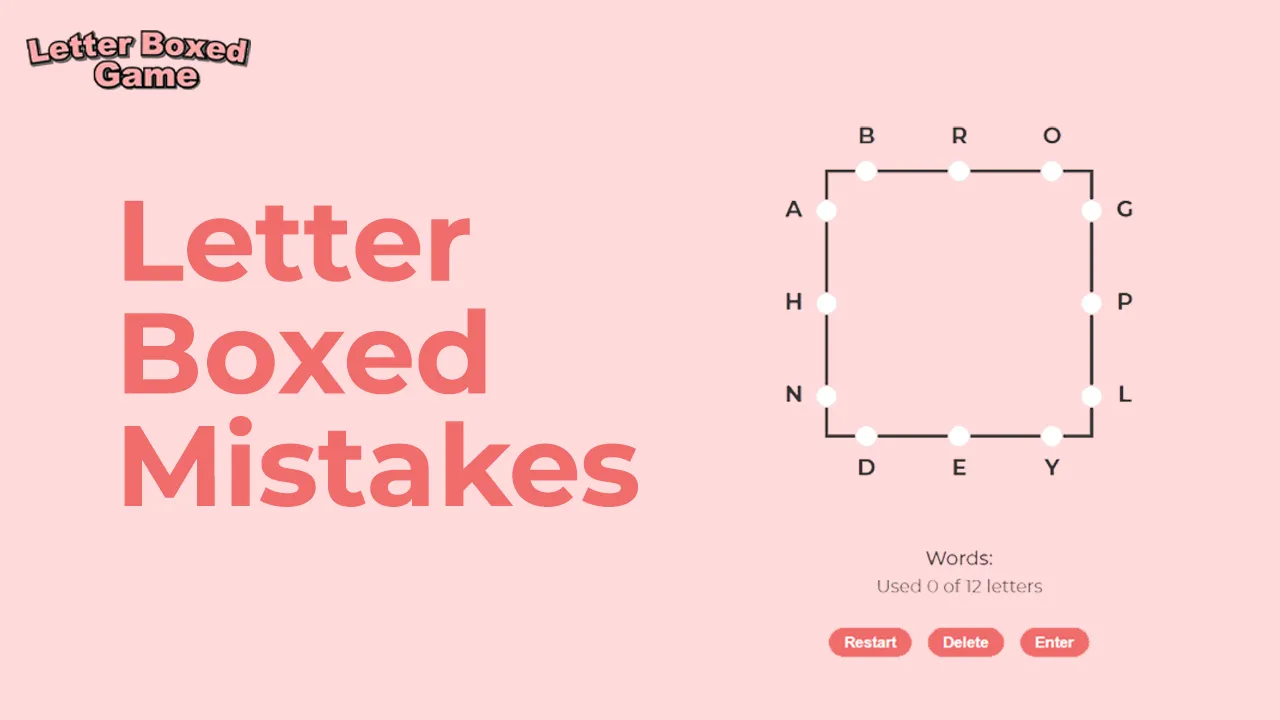
Why Recognizing Your Letter Boxed Mistakes Matters More Than You Think
Letter Boxed isn’t won by luck or big vocabulary alone. It’s won by patterns, strategy, and understanding where your process goes wrong.
When you spot your bad habits, you stop guessing and start solving with intention, something you’ll notice immediately in daily puzzles.
Classic Letter Boxed Mistakes Beginners Repeat Over and Over
Starting With the First Word That Comes to Mind
This is the beginner trap. When players rush in and drop the first word they see, they instantly limit their connections. It’s like building a house starting with the roof you’ll eventually need to tear down.
The fix: Take 5–8 seconds to scan all four sides and identify the bridge letters—letters that naturally link two or more sides.
Try this in your next puzzle: Before choosing any word, list 2–3 letters that appear most connectable and build around those.
Treating the Sides as Walls Instead of Letter Clusters
Many players think in terms of left → right → top → bottom rather than clusters → transitions. That mindset traps you in awkward letter jumps.
Better mindset: See the puzzle as four buckets of letters that need fluid pathways between them.
Example: If you have sides like:
- APL — RTE — MOD — SCN
- Instead of thinking “left → right,” think: APL → link to RTE → end in E that connects to MOD, etc.
Ignoring High-Value Connector Letters
Connector letters are the glue of Letter Boxed. Ignoring them makes puzzles much harder.
Typical connectors: R, S, T, E, N
These letters often appear in words that can start or end almost anything.
Example mistake: Using “MOON” when the board has an “R” that would create far more transitions.
Forgetting You Only Need Two Words to Win
Players often chase 3–4 word chains because they think they must use every letter in balanced chunks. That’s not the goal.
Your goal: A path, not equality.
Quick fix: Always attempt a 2-word solution first, even if it looks messy. You’d be surprised how often it works.
Relying Only on Simple Common Words
Using basic nouns like “car,” “map,” “rate” feels safe, but safe words lead to dead ends.
Instead, use:
- Prefixes: pre-, re-, anti-, ultra-, over-
- Suffixes: -ing, -tion, -er, -ment
- Abstract connectors: enter, into, across, order
These create multi-directional options, which reduce roadblocks.
Not Performing a Quick Dead-End Check
Dead ends happen when your ending letter has no viable follow-ups.
Example:
- Ending with “Q”
- Ending with “J”
- Ending with “Z”
- Ending with letters that aren't present on the next side
Fix: Before locking in a word, ask: Can the ending letter connect to at least 2–3 letters on another side? If not, skip it.
Skipping the Final Optimization Pass
You find a 3-word solution and feel the rush. But pros refine their path. Optimization often turns a messy 3-step route into a clean 2-word finish.
Try this: After solving, reverse-engineer your first and last words. Can you replace either with a more flexible word? Most times, yes.
Advanced Letter Boxed Mistakes Even Experienced Players Make
Over-Focusing on One Side of the Box
“Side obsession” traps you in linear thinking. Good players scan all sides equally before committing.
Using Rare Words Too Early
Rare words lock you into rigid paths. Use them only when:
- You need a forced ending
- The puzzle has a limited transition pattern
- It appears near the end of your solution
Not Mapping Letter Frequency First
High-level players quickly identify:
- The most frequent letters
- The most isolated letters
- Connections between these two categories
This removes guesswork.
Not Considering Reversible Word Paths
Some words work better backward. Example: “Enter” might not open many doors, but “Rente” or “Renter” might. Try flipping start/end words during optimization for better transitions.
Failing to Identify 2-Step Synergy Words
These are words that naturally chain to strong finishing letters. Examples:
- Order → ends in “R”
- Stone → ends in “E”
- Caster → ends in “R”
- Motion → ends in “N”
These endings fuel powerful second-word options.
Mistakes That Slow Down Your Problem-Solving Process
Overthinking Instead of Pattern Spotting
Letter Boxed rewards recognition, not rumination. Overthinking often leads to weak paths.
Not Building a Mental Word Bank
You don’t need 10,000 words. Focus on:
- Connectors
- Abstract nouns
- Morphology-based words
- Reversible words
Experience builds this naturally, but you can accelerate it.
Ignoring Thematic Word Clusters
Themes often create smoother chaining. Look for clusters like:
- Animals
- Places
- Science terms
- Food
- Technology
- Business
If you notice a cluster forming, lean into it.
How to Fix These Mistakes: Your Tactical Strategy Kit
Strategy Table: Bad Move → Better Move → Optimal Move
| Scenario | Bad Move | Better Move | Optimal Move |
|---|---|---|---|
| Starting word | Using the first word you see | Using a word with common letters | Using a bridging word that connects two sides |
| Ending word | Ending with an awkward letter | Ending with a vowel | Ending with a high-option consonant like R or N |
| Dead ends | Not checking transitions | Checking next side only | Checking all possible side transitions |
| Word style | Simple nouns only | Mix of nouns and verbs | Morphology-rich words with dynamic endings |
A Simple 4-Step Framework to Avoid 90% of Mistakes
- Scan all sides for connectors.
- Choose one anchor letter with a high link value.
- Build a possible 2-word finish first before anything else.
- Check for dead ends before committing.
This approach can dramatically improve your win rate.
Examples of Mistakes Turned Into Smart Solutions
Example 1: Bad Path → Good Path → Optimal Path
Bad path: Rate → Enter → Tornado (Three words, awkward transitions)
Better path: Renter → Tornado (Two words, smooth ending on “O”)
Optimal path: Caster → Rondo (Clean, elegant, efficient)
Helpful Tools to Improve Word-Solving Skills
These tools strengthen vocabulary and pattern recognition:
- WordUp vocabulary app
- Power Thesaurus
- Cambridge Morphology Dictionary
- Word root flashcards
- Simple puzzle notebook to track starting words and endings
Bonus Strategy: Player Personas and Mistake Patterns
- The Overthinker: Gets stuck analyzing instead of playing. Fix: Set a 60-second limit per attempt.
- The Speed Solver: Moves too fast and locks into weak paths. Fix: Pause after the first word and reassess.
- The Category-Locked Player: Forces categories that don’t fit. Fix: Mix abstract and concrete words.
- The Collector: Tries to use every letter evenly. Fix: Focus on paths, not balance.
Final Thoughts
If your solutions feel inconsistent, it’s not that you’re bad at the game, you’re repeating patterns that don’t work. Notice your mistakes, fix them with these strategies, and your consistency will improve by playing Letter Boxed unlimited again and again. Applying these tricks ensures that each puzzle feels more manageable and rewarding.